
Bunnies & Burrows (B&B) is a role-playing game (RPG) about rabbits contending with enemies and hazards in a world of nature. Published by Fantasy Games Unlimited in 1976, the game features intelligent animals as characters in lieu of the humans and allied races of conventional RPGs. B&B introduced several innovations to role-playing game design, being the first game to allow players to have non-humanoid roles, the first to allow players to advance in different skill categories, and the first to provide detailed combat skills. Fantasy Games Unlimited published a second edition of the game in 1982, and the game was modified and republished by Steve Jackson Games as an official GURPS supplement in 1992.
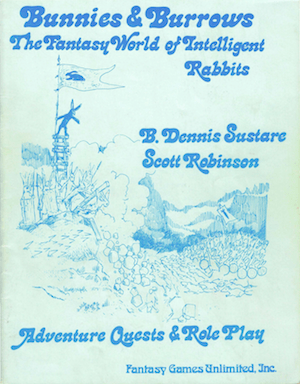
Originally published only two years after the first role-playing game Dungeons & Dragons was published, this edition is now long out of print. The game was inspired by Richard Adams’ fantasy novel Watership Down, and the players were given the opportunity to take on the role of rabbits. As such, the game emphasized role-playing over combat for, according to Steffan O’Sullivan, “You’re playing a rabbit, after all – how much combat do you want to do?”
Players new to role playing games, and experienced hands accustomed to outfitting dwarven warriors, elven rangers, or human wizards, might be puzzled by a game about rabbits. What, after all, can a rabbit do, except eat, sleep, groom itself, run away from danger, and possibly end its life in the jaws of a fox? Rabbits have been depicted in myths and stories as tricksters and merrymakers, magicians and warriors, with abilities ranging from almost-real-world rabbits (as in the novel Watership Down, by Richard Adams) to the anxious, waistcoated White Rabbit (of Alice in Wonderland) to swashbuckling heroes (as in the Redwall novels of Brian Jacques).
Well, the bunnies of B&B are closer to natural rabbits than to Wind in the Willows. They may not wield a sword or drive motor cars, but they can fight (much better than you might expect), spring traps without getting caught, use their wits to outfox a fox or trick a coyote trickster, bargain and persuade other rabbits and even other animals (if they know the language), carry things (tucked in their fur, or in a woven bird nest used as a bag), count (but only up to four), disguise themselves, and tell fabulous stories. Some rabbits may possess more fantastic abilities: they might glimpse events in the future, master the lore of herbalism (the closest thing rabbits have to magic), heal wounds by laying on of paws, and use certain other mental powers. Our own experience has found that the game has a tendency to evolve during play, with rabbits devising new ways to do more complicated things, and thereby becoming more versatile and powerful. Most of all, playing ostensibly small and weak characters such as rabbits, squirrels and opossums encourages players to use their imagination, instead of relying on brute force to solve every problem.
 Scott R. Robinson