
The first edition of Bunnies & Burrows was published by Fantasy Games Unlimited in 1976, with art by Charlie Loving. It was noteworthy for its time by being the first roleplay game with non-humanoid player characters, and also the first in which characters could level-up in different skill categories (based on the eight attributes). Now, of course, those features are very common in both paper and computer RPGs. Character setup and play mechanics used both six-sided dice and percentile dice. Only rabbits could be player characters, and each one was initially rolled up by straight 3d6 for each of eight primary characteristics, or attributes.

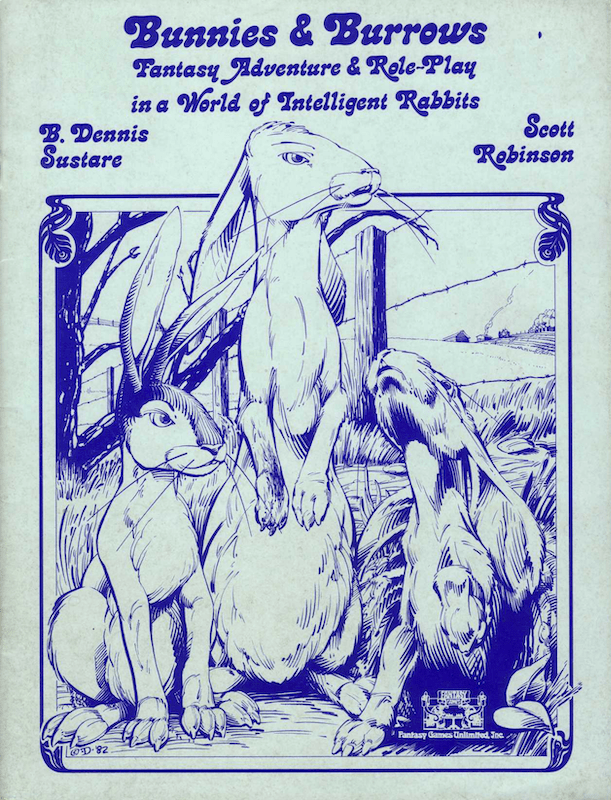
The second edition, also by FGU, was released in 1982. This had new cover art and a couple of interior illustrations by Jeff Dee, but was essentially the same as the first edition except for more professional typesetting and some clarifications and corrections of typos.
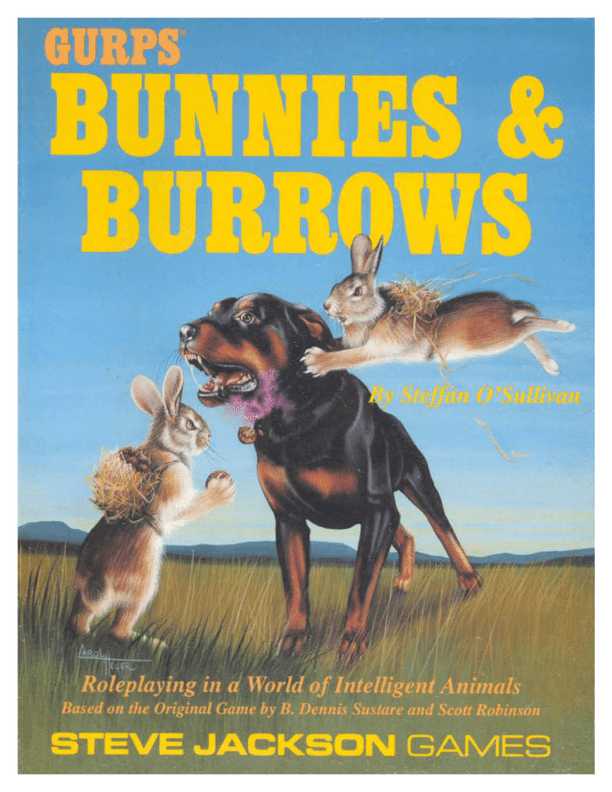
A complete revision inspired by the original edition was done by Steffan O’Sullivan for the GURPS system, which was published by Steve Jackson Games in 1992.
In 2019, Frog God Games published the completely new third edition. As creators of B&B, we bring decades of experience and nearly two years of imagination and labor to this completely revised edition of Bunnies & Burrows. Since the appearance of the original edition, Dennis has remained active in the gaming community as both player and designer. Scott, on the other hand, has retained a more casual connection to RPGs, gravitating more to the imagination of occasional role play than the gradual build-up of character traits and treasure over hundreds of hours of gaming. We hope that this new edition of B&B will provide gaming opportunities for both kinds of players.
Although our gaming styles differ in some respects, we share an appreciation for simple game mechanics over tedious comparison of die rolls against tables of possible outcomes. B&B has a core set of basic rules that simplifies game play for many of the most time-consuming phases of a game, such as combat and herbalism (the bunny equivalent of magic). However, we also offer extended rules and mini-games as a source of complexity and realism. Dennis, for instance, particularly appreciates the availability of tactical options in combat situations, while Scott greatly wanted to introduce a quasi-realistic option for pursuit, which is probably the most important form of predator-prey interaction in nature.
In short, we have gone through the entire game system in detail, adding elaborations in some places, simplifying parts that were confusing, streamlining play, and totally revising combat and herbalism rules. In addition to the original eight rabbit professions, you can now play one of eight non-rabbits (skunk, squirrel, raccoon and more), each with their own characteristics and skills. We also have simplified our approach to skill tests and saving throws. The new rules use only six-sided dice, not percentile dice. Character creation also gives you a little more flexibility than in the original rules.
We also have offered Extended rules throughout the game that can be used or ignored, at the players’ discretion. Extended rules particularly apply to Pursuit, Combat, and the crafting of Herbs. Mini-games for above and below-ground combat, springing traps, searching for herbs, and even crossing a frozen river, also offer opportunities for players to take a break from pencil and paper and resolve a situation as miniatures on a specialized board. Pre-drawn Adventures are available with characters ready to use, as well as guidelines for new or experienced gamemasters that want to create his or her own campaign. We hope that this new edition of B&B will permit players to choose the simplicity or complexity that best suits their preferred style of play.
 Scott R. Robinson