A common trope in both fantasy literature and fantasy gaming features animals that possess human cognitive abilities. Classic books, including The Jungle Book (1894) by Rudyard Kipling, The Wind in the Willows (1908) by Kenneth Grahame, the Peter Rabbit books (1902 and subsequent) by Beatrix Potter, Animal Farm (1945) by George Orwell, and Charlotte’s Web (1952) by E. B. White, are so familiar that they have become incorporated into our common culture. All are still in print, and all have been adapted for cinema or television media.
A more recent novel that became an instant classic—Watership Down (1972) by Richard Adams—is approaching its 50th anniversary. Watership Down also is still in print and has been adapted as an animated feature film (1978), an animated television series (1999-2001), and most recently as a miniseries with computer generated animation on Netflix (2018). But Watership Down is not the only story featuring animal characters that have recently seen renewed interest. Two film versions of the Jungle Book have been released in the past few years: The Jungle Book (2016), the second adaptation of the novel by Disney, and Mowgli (2018) two years later on Netflix. Both featured live action mixed with computer animation. The same is true of Peter Rabbit (2018) and it’s sequel, Peter Rabbit 2: the Runaway (to be released December 2020).
Then you have The Lion King, first a beloved Disney animated film (1994), then the third longest running, highest earning production in the history of Broadway (1997 to present), a series of direct-to-video sequel films, and most recently a new photorealistic animated film from Disney (2019). To date, the film has grossed more than $1.6 billion, earning records as the highest-grossing animated film and highest-grossing musical. Spoiler: a sequel is in the works.
The long-standing success of animated films featuring animals may be one reason why animal characters remain popular in literature aimed at a middle-grade audience. Prime examples of these animal novels are the Redwall series by Brian Jacques (23 books from 1986 to 2011), the Guardians of Ga’hoole by Kathryn Lasky (16 books from 2003 to 2013), and multiple series by the pseudonymous Erin Hunter (Warriors, Seekers, Survivors, Bravelands; at least 65 books, with associated manga stories, novellas, and guides thrown in, published from 2003 to 2020).
Apart from the film adaptations and children’s books, there also are noteworthy entries in the animal novel category for more literary audiences. In Empire of the Ants (1991), penned by Bernard Werber and named after the H. G. Wells short story (1905), a human researcher and an intelligent ant colony discover each other. Laline Paull’s The Bees (2015), which was nominated for the Baileys Women’s Prize for Fiction, infuses a story of the life of one honeybee with real science. In the War with No Name trilogy (Morte, Culdesac, D’arc, 2015-2017) by Robert Repino, an intelligent race of ants bestows human intelligence upon dogs and cats, who wage war on humankind. And of course I am ignoring the plethora of books that feature humanlike characters with more animal characteristics, such as vampires, werewolves, and zombies.
Although literary agents and editors I’ve spoken with often are reluctant to admit it, the prevalence and success of such animal-based stories speaks to the enduring interest in the lives of intelligent creatures that are not human. Many of us who have pursued careers in science have sought to understand the real lives and intelligence of animals in real-world settings. Much of my own interest in works of animal fiction is playing out the thought experiment of what we might learn if we could speak with animals. (It should not be surprising that the first novels I fell in love with were the Doctor Dolittle books by Hugh Lofting, although I admit the movie adaptations have been horrible.)
With this interest in animal fiction in mind, it is useful to draw a distinction between two very different kinds of animals as depicted in literature and film. For convenience, I will refer to these as the Fingered and the Unfingered. This distinction is not original to me; I read it first in the advice to gamemasters for the GURPS edition of Bunnies and Burrows, adapted by Steffan O’Sullivan from the original version by B. Dennis Sustare and myself. I’ll let Steffan speak for himself:
Animals in fiction fall roughly into two categories: those that are represented with their natural paws, and those that are given human-like hands. This one distinction sets the whole tone of the degree of cinematic action. Most of the differences in animal fiction can be boiled down to fingered animals vs. non-fingered animals.
Fingered animals are those that are given human fingers, of course. This is especially popular in comic books and children’s books. These animals usually stand on two legs and have arms that function as if their ancestors evolved in trees, further heightening the level of anthropomorphism. Toad in The Wind in the Willows drives motor cars, for example (though rather recklessly!), while certain well-known turtles use Oriental martial arts weapons.
Non-fingered animals are portrayed more realistically, but are often still cinematic. Watership Down, Tailchaser’s Song, and Duncton Wood are good examples of this genre. The animals walk on all fours and cannot manipulate tools with their paws—but they converse and carry on like humans, anyway! There is always a degree of anthropomorphism in any animal book, even National Geographic specials, no matter how pure zoologists try to be.
I would take Steffan’s distinction a step further. Fingered animal characters are really not animals at all, but humans in animal clothing. The mice in Redwall have swords and armor and share the same motivations as human and humanoid characters from traditional fantasy stories. The rats in The Secret of NIMH have technology and books and aspirations completely unlike real animals, except for very basic motives such as self-preservation and protection of family. Animal stories with fingered characters are really allegories for the human condition. In my opinion, they do little to offer insight into the lives of actual animals.
There is a long tradition of using animals as stand-ins for moralistic tales about human behavior. Aesop (6th century BCE) used animal fables to point out human foibles. Reynard the Fox was a standard satire aimed at the aristocracy and clergy during the high middle ages, dating from the 12th century. Medieval manuscripts often were illuminated with animal figures smiting wicked people, or conversely, tormenting the saintly.
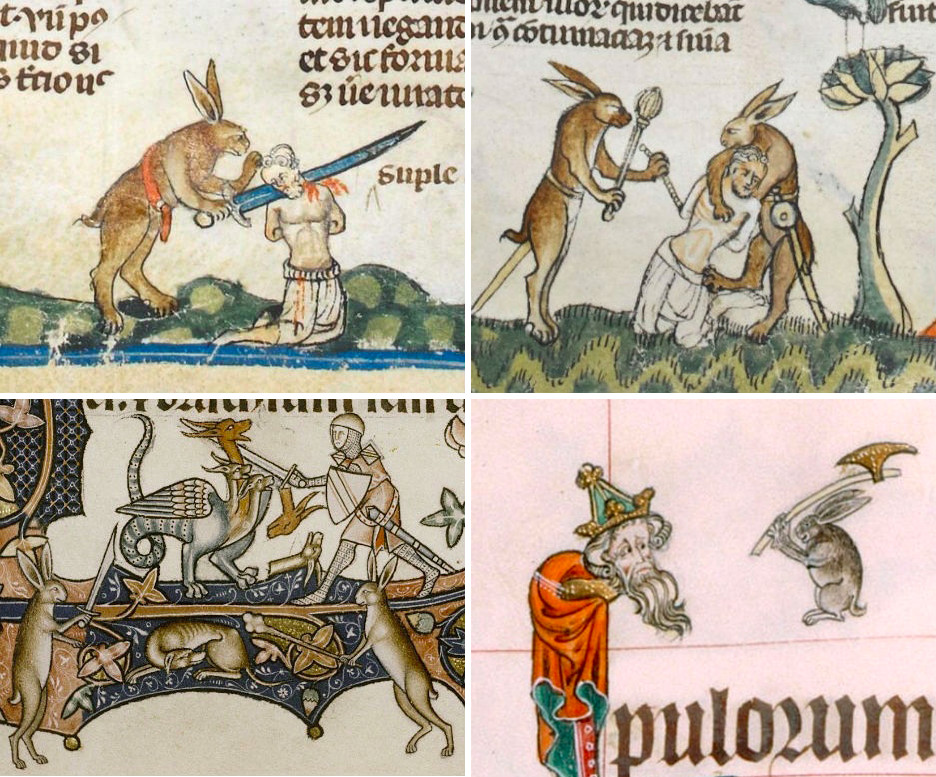
In contrast, non-fingered characters have some human characteristics, such as language, and perhaps rudimentary technology, but they are fundamentally animal in their goals and abilities. The rabbits of Watership Down, for all the biological mistakes perpetuated by Richard Adams, are nevertheless rabbits, who seek a safe place to live where they can build families. In the games of Bunnies & Burrows that I run, the player characters are immersed in a world that is fundamentally animal, where they have to worry about eating and not being eaten. I generally avoid traditional fantasy tropes, such as prophecy, the eternal battle between good and evil, the chosen one, and similar themes. Although they value certain foods, bunnies do not quest for arbitrary treasure or fortune. And they positively do not wear armor, wield swords, or weave magical spells (although herbs come pretty close).
There is room in literature and gaming for both kinds of animal characters. For my part, however, I continue to appreciate fiction that gives us insight into real life. It’s just that the real lives I’m interested in exploring are not human.
 Scott R. Robinson